

Anthropic 2030

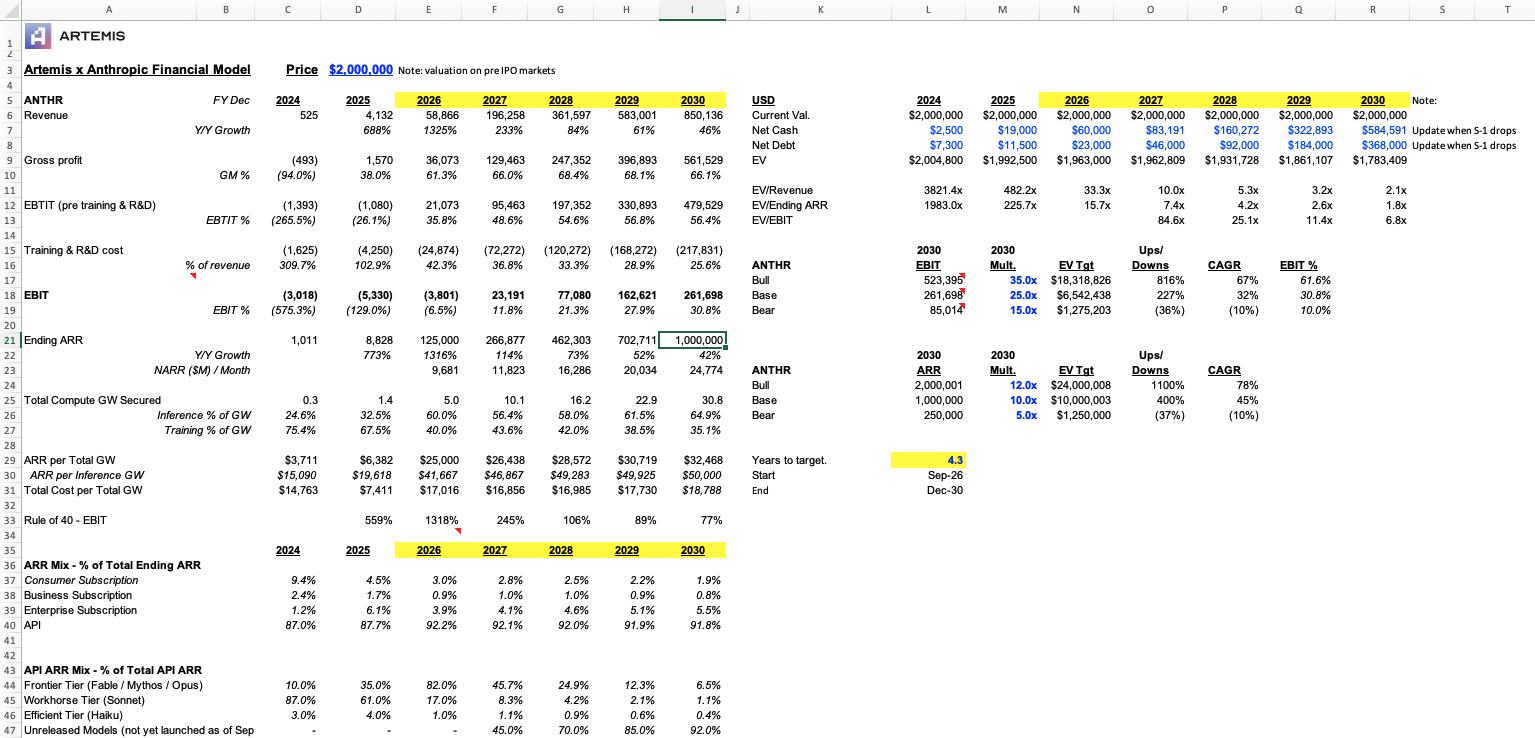
Full 2030 financial model
 Get the full model (.xlsx) via text
Summary
Anthropic will be the first $10T company in the world because enterprises cannot get enough of their frontier models and product suite.
- Open source is not a credible threat on spend: we at Artemis shifted our own tokens toward open weights and still spend 97% of our AI budget on Anthropic.
- Agents are still under 1% deployed worldwide and extremely early on the S-curve. Demand for tokens will going to go exponential.
- Compute constraints will be resolved: a record IPO that could net $100B+, and a strong ex-Blackstone CFO in Krishna Rao, could comfortably secure 30+ GW by the end of the decade (if not more).
In short, Anthropic is a clear long at $2T, but unclear above >$3T given risks around open source, OpenAI models catching up, and cost of compute rising.
Thesis: Anthropic is the AWS of AI
In 2015, skeptics viewed AWS as a vastly unprofitable cost center at Amazon, providing a commoditized product similar to electricity, and were unclear if the cloud market was large. To make matters worse, there were concerns competitors like Google and Microsoft would hurt AWS pricing.
Fast forward to 2026, Amazon is the undisputed winner of cloud, building a formidable business that has scaled beyond their initial S3 product through its one-stop-shop suite of products, economies of scale, and developer ecosystem.
In 2026, Anthropic faces similar concerns that their frontier models will be commoditized due to open source players even though they have raised and burned billions of dollars.
We believe Anthropic, with their incredibly talented team will not just keep pushing the boundary of frontier models, but also build an incredibly sticky one-stop shop suite of AI products that allow enterprises to easily build, scale, and maintain AI systems for every single enterprise vertical in the world. These include but are not limited to domain specific frontier models like models for drug discovery, and also tooling to ensure AI safety, compliance, performance optimization and more.
Anthropic will create enterprise lock-in, be able to build high 60s gross margin over time, and build and incredibly profitable business like AWS AND surpass AWS in ARR in 2027.
The Essence of Anthropic (aka what to Watch for in the S-1)
Anthropic really boils down to 1) can Anthropic hire talented researchers to develop frontier models 2) acquire and keep costs of acquiring compute down ($10-$15 per MW) and 3) charging a premium for tokens via API (e.g $50m ARR per MW).
What this looks like from the key metrics that matter:
- Demand: Net new ARR is in our estimate $10-$15B/month and with token volumes going up even as token prices are going down, demand for frontier models and to deploy agents in businesses is fairly de-risked.
- Supply: Total Compute Secured (GW). Its reported that Anthropic has between 15-16 GW secured through 2030 and will require at least 20 GW of training compute to service $1T ARR which we think is doable by 2030 (OpenAI is reported to secure at least 30 GW of total compute by 2030)
- Gross Margin: The gap between $M ARR per MW that Anthropic is able to charge and $M per MW for compute that Anthropic charges is the crux of how profitable Anthropic can be long term and if its a good business or not.
In addition:
- Anthropic = an enterprise API business. 90% of Anthropic ARR comes through the API. The $10T outcome relies on Anthropic ability to sell their models direct and also through AWS Bedrock / Gemini Enterprise Agent Platform / Microsoft Foundry. Consumer plans are insignificant.
- Net ARR, not gross. Investors will underwrite revenue net of the 15-20% share paid away to AWS, Gemini, Microsoft and remove Meta revenue and Chinese AI labs distilling Anthropic’s models.
What could go right
A lot could go right.
In our base case, Anthropic is able to secure a total of 30.8+GW by 2030, able to service $1T ARR, and total cost per MW of compute is $18 and total ARR per inference MW is $50m.
That implies steady state gross margins of 66%, EBIT of 30% and total training & R&D dropping to ~25% of revenue.
In this state, Anthropic is extremely profitable, growing quickly as agents continue to proliferate all 300m+ businesses globally.
Worth in 2030Against today’s $2.0T mark: bear $1.0T, base $8.0T, bull $12.0T.
What could go wrong
In order of probability:
- High Risk: Codex and OpenAI Astra take share from Anthropic: we’ve started to see anecdotally our own engineers shift from Claude Code to Codex. We’ve noticed from experimenting with Astra and Fable this past weekend how much the gap has closed and customer shifting towards OpenAI could Here are a few supporting customer quotes.
- Blockchain Data Lead at Artemis: “anecdotally I’ve been using Codex and I prefer the way it communicates. I think some people treat them as complements in that they use Claude Code to plan and Codex to execute. I seem more as substitutes, using Codex only. I was formerly a heavy Claude Code user in the terminal. Now prefer Codex in the ChatGPT app.”
- Fintech Analyst at Artemis: “OpenAI’s codex applications so good and can visualize what agents are working on and clearly built for programming. The first phase of Claude Code in a CLI was good, and now Codex GUI is so much better at seeing what agents are doing. Claude code was great at creating the first generation of coding in CLI, but I think the second generation you will see in an application with a GUI.”
- PM at $3B company: A friend of ours who is a major proponent of Claude Code / Claude Harness shared the following this weekend: “Wow, dude. I’ve got to say. Astra is incredible”
- High Risk: Low Switching Costs Between Models: 25% of Q2’26 gross revenue flows through third parties like AWS Bedrock and the Gemini Enterprise Agent Platform. Through AWS Bedrock, Anthropic serves an API that an enterprise can swap for OpenAI’s Astra and other open weight models. Anthropic is in a tough position if they do not have SOTA models, enterprises could easily swap models and revenue could shift significantly.
- Medium Risk: Harnesses like Grokbot and Instinct don’t require Anthropic: Grokbot is built on the x.ai frontier model challenging Claude Cowork and Claude’s harness. If instinct and new AI apps are built on open source or other frontier models, this could put pressure on Anthropic to move up the stack and acquire harnesses / applications or be forced to innovate similar to what they did with Claude Code, Claude Design, Claude Cowork.
- Lower Risk: Compute cannot be secured. Anthropic already has close to 15 GW secured and need another 15GW to service $1T of ARR. A $100B+ IPO allows Anthropic to secure compute. That said, Amazon, Nvidia, Google and SpaceX are suppliers and shareholders and competitors at once (Amazon has Titan, SpaceX has Grokbot, Nvdia is moving up the stack with HuggingFace). We view this as very unlikely too.
- Lower Risk: Anthropic stops shipping frontier models. Either researchers get rich enough off the IPO to stop caring, or they hit a technological bottleneck. Right now there is a perfect confluence of incentives but what happens when researchers’ grants are worth $150-300M? A $5-10M grant at $100-200B valuation is worth nine figures at $3T. We find Ant’s ability to ship SOTA models unlikely.
Valuation and last word
Even among high growth software and AI comps, Anthropic is cheap at $2T on a EV / ARR and EV / NTM Revenue basis (and even at $3T it doesn’t look crazy)
We believe Anthropic goes public in mid / late October at $2T and retail and institutional demand pushes it to $3-4T.
Truth be told on, Anthropic might be a buy regardless.
- Anthropic’s $65B net ARR reported in July ’26 suggests 15x YoY and our $90B estimated end of Sept ’26 ARR growing 15x YoY is generational.
- In addition, our forecasts (which is MORE conservative than Semianalysi’s $300B ARR in 2027) of $125B ARR end of 2026 and $275B ARR end of 2027 implies 20x 2026E ARR, and 7.2x 2027E ARR.
- For truly one of the fastest growing public companies of all time that is the CLEAR winner of enterprise AI, it’s hard not to be long $ANTHR.
How does one even value a company that could develop AGI and sell it to be 300m+ businesses globally that would happily replace or augment white collar workers with intelligence? Our back of the napkin math of 300M businesses * replacing 1 white collar worker at $120 ACV = $36T in potential AI spend globally. What if Anthropic takes 20% of that ($7.2T ARR)? 30% ($10.8T ARR)?
Ramp estimates that 56% of US businesses spend on AI but at a median rate of $12/month. Our belief is that its businesses spend on ChatGPT or individual subscriptions on Claude.
Our long term belief is that agents — not chatting with agents via Claude or ChatGPT — is what will accelerate AI spend globally and beyond for a market where agents are still <1% of global business.
Simply put, our base case of $1T of ARR in 2030 might actually be too conservative.
What if super intelligence arrives and Anthropic is able to build their models with their own models and the cost of research plummets and margins expand? What if super intelligence is only available via Anthropic, the willingness to spend skyrockets and the $50m ARR per MW might be too conservative?
Time will tell with these frontier models getting closer to super intelligence.
To close, I’m reminded by the following quote from the CFO at Anthropic: “Humans mostly think linearly and incrementally. I’ve been at [Anthropic] for two years. That’s a paradigm I’ve had to break for myself. To stop just thinking linearly and think in exponentials”.
Congratulations to Anthropic and excited for the S-1 and the exponential growth ahead as we reach super intelligence.